Planning to study in the United Kingdom in 2027? Getting admission to a UK university is an important milestone, but obtaining your Student visa is equally important.
Indian students applying for a UK Student visa need to understand the latest immigration requirements, financial evidence, Confirmation of Acceptance for Studies (CAS), English-language requirements and application process.
A small mistake in your financial documents, incorrect information or incomplete application can cause delays or even refusal.
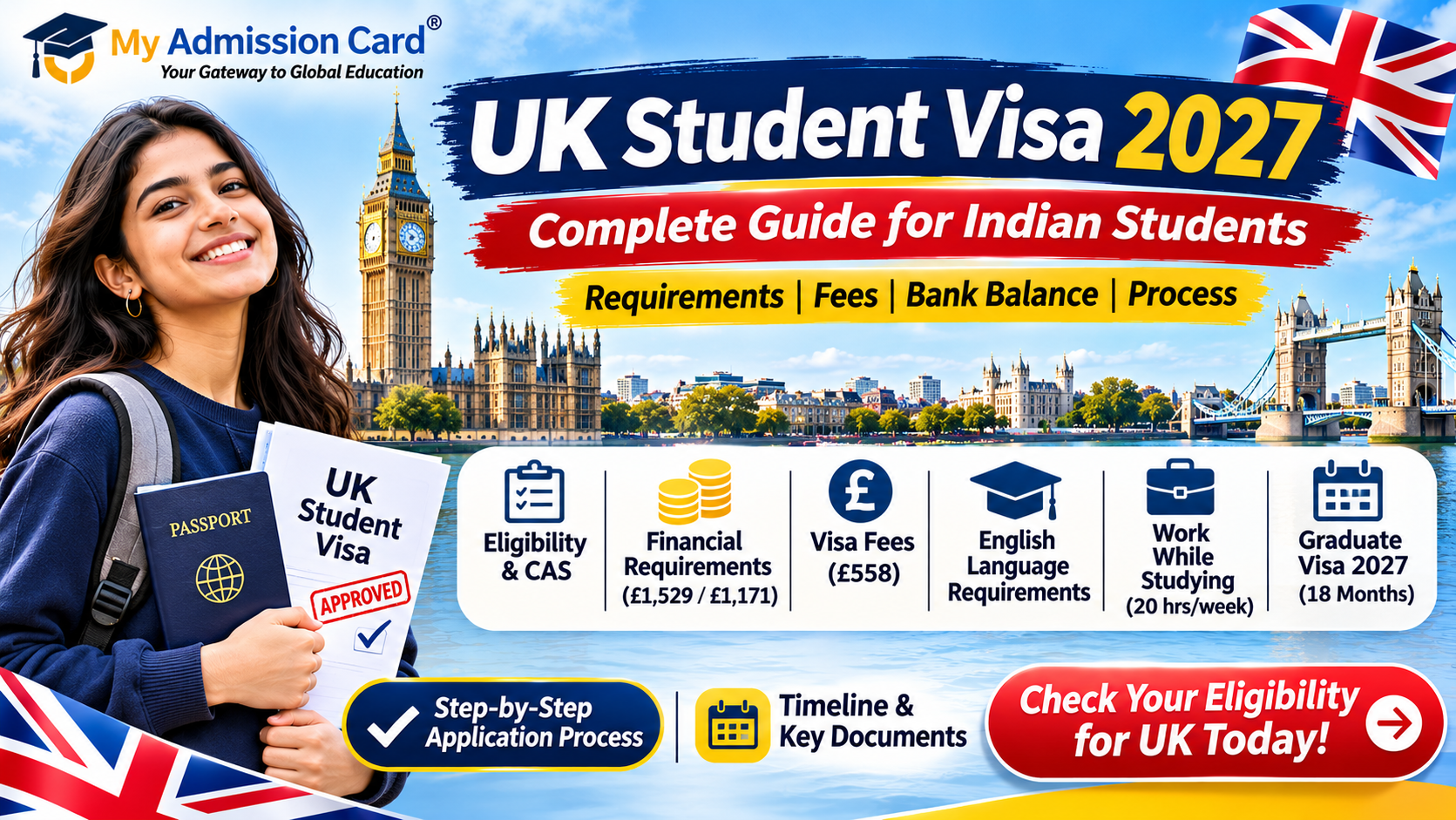
This comprehensive guide explains the UK Student Visa 2027 requirements for Indian students, including the minimum bank balance, visa application fee, documents, eligibility criteria, work permissions and application process.
Whether you are planning to study an undergraduate degree, postgraduate programme or another eligible course, this article will help you prepare for your UK education journey.
1. What Is the UK Student Visa?
The UK Student visa allows eligible international students to enter or remain in the United Kingdom to study an eligible course with a licensed student sponsor.
Indian students generally need a Student visa if they are planning to study a full-time degree or another qualifying programme lasting longer than six months.
To qualify, you generally need to:
- Receive an offer from a UK university or eligible education provider.
- Obtain a Confirmation of Acceptance for Studies (CAS).
- Meet the English-language requirements.
- Demonstrate sufficient financial resources.
- Meet the relevant immigration requirements.
- Provide the necessary supporting documents.
Official information: https://www.gov.uk/student-visa
2. UK Student Visa Requirements for Indian Students in 2027
Before applying, make sure you meet the main eligibility requirements.
A. Confirmation of Acceptance for Studies (CAS)
A CAS is an electronic reference issued by your UK education provider after you have accepted an eligible offer and fulfilled its applicable conditions.
It contains important information, including:
- Your university or education provider.
- Your selected course.
- Course start and end dates.
- Tuition fee information.
- Any tuition fee deposit already paid.
- English-language assessment information, where applicable.
You will need your CAS reference number when completing your Student visa application.
Important: A university offer letter and a CAS are not the same thing. You cannot normally complete a Student visa application without the required CAS.
B. English-language requirements
Students must demonstrate the required level of English proficiency.
For degree-level study, the general requirement is CEFR B2 across reading, writing, speaking and listening. For courses below degree level, the general requirement is B1.
Depending on your circumstances, English proficiency may be demonstrated through:
- An approved Secure English Language Test (SELT).
- A qualifying UK qualification.
- A qualifying degree taught in English.
- An assessment conducted by an eligible higher education provider.
If you completed an English-taught degree outside the UK, you may need an Ecctis assessment to confirm the qualification's UK equivalence and that it was taught in English.
An MOI certificate alone does not automatically satisfy the Student visa English-language requirement.
Official guidance: https://www.gov.uk/student-visa/knowledge-of-english
C. Financial requirements
You must demonstrate that you have sufficient funds to cover the required course fees and living expenses.
The amount depends on where your university is located and how much tuition fee remains unpaid.
The financial requirements are explained in detail below.
D. Valid passport
You need a valid passport or other accepted travel document.
Make sure your personal details match the information in your university application and CAS.
3. UK Student Visa Bank Balance 2027: How Much Money Do Indian Students Need?
This is one of the most frequently searched questions by Indian students planning to study in the UK.
Under the currently published UK financial requirements, students must demonstrate sufficient money for their unpaid course fees and living expenses.
The monthly maintenance amounts are:
Study locationMonthly living expensesMaximum 9-month requirementLondon£1,529£13,761Outside London£1,171£10,539
These are the published maintenance amounts for the 2026/27 requirement.
Example 1: Studying in London
Suppose you are planning to study at a London university.
Your required living-cost funds for nine months would be:
£1,529 × 9 = £13,761
You must also demonstrate the required unpaid tuition fees for the relevant period.
Example 2: Studying outside London
Suppose your university is in Birmingham, Manchester, Leeds or another location outside London.
Your required living-cost funds for nine months would be:
£1,171 × 9 = £10,539
Again, you must add the required unpaid tuition fees.
Important bank balance rules
Your financial evidence generally needs to meet the following conditions:
- The required funds must be held for at least 28 consecutive days.
- The 28-day period must end within 31 days before the visa application date.
- The account must meet the applicable UKVI requirements.
- The money must be immediately accessible.
- If you use your parent's funds, you must provide the required parental consent and relationship evidence.
Accepted financial evidence may include eligible bank statements, official sponsorship and qualifying student loan documentation.
Overdrafts, cryptocurrency, stocks and shares and certain other financial assets cannot be used as acceptable funds.
Important: The financial requirements can change. Always calculate your required funds using the official UK government guidance immediately before submitting your application.
Official source: https://www.gov.uk/guidance/financial-evidence-for-student-and-child-student-visa-applicants
4. UK Student Visa Fees in 2027
Students should budget for the visa application fee and Immigration Health Surcharge (IHS), in addition to tuition fees and living expenses.
The currently published Student visa application fee for applications made outside the UK is:
£558 per applicant.
You will also normally need to pay the Immigration Health Surcharge as part of your application. The amount depends on the length of your visa.
Other possible expenses include:
- TB test charges, where applicable.
- English-language test fees.
- Document translation costs, where applicable.
- Optional priority visa services, if available.
- Travel and accommodation expenses.
Always check the latest official charges before submitting your application.
Official visa fee information: https://www.gov.uk/student-visa
5. Documents Required for a UK Student Visa from India
Preparing your documents correctly is an essential part of the application process.
Here is a general checklist for Indian applicants.
DocumentPurposeValid passportIdentity and travel documentCAS referenceConfirms your eligible course and sponsorFinancial evidenceDemonstrates funds for fees and living expensesEnglish-language evidenceDemonstrates required English proficiencyTB test certificateRequired where applicableATAS certificateRequired for certain courses and nationalitiesAcademic documentsSupports your academic backgroundParental consentRequired for applicants under 18Sponsorship documentsRequired where relevant
The exact documents depend on your personal circumstances and the course you intend to study.
Do Indian students need a TB test?
Indian applicants applying for a UK visa for more than six months will generally need a tuberculosis test certificate from a Home Office-approved clinic, subject to the applicable exemptions.
You should arrange your test at an approved clinic and check the validity of the certificate before applying.
Official guidance: https://www.gov.uk/tb-test-visa
6. UK Student Visa Application Process: Step by Step
Here is a simple overview of the application journey.
Step 1: Select your university and course
Research universities based on your academic background, career plans, tuition budget and preferred location.
Step 2: Apply for admission
Submit your application with the required academic documents, English-language evidence and other supporting information.
Step 3: Receive your offer letter
Your university may issue a conditional or unconditional offer depending on your eligibility and outstanding requirements.
Step 4: Pay the required tuition deposit
Follow your university's instructions regarding tuition fee deposits and payment deadlines.
Step 5: Receive your CAS
Once the university has completed the relevant checks and confirmed your eligibility, it can issue your CAS.
Step 6: Prepare financial documents
Calculate your required maintenance funds and ensure your financial evidence satisfies the 28-day rule and other applicable requirements.
Step 7: Complete your online visa application
Apply through the official UK government website and pay the relevant visa application fee and Immigration Health Surcharge.
Step 8: Complete biometrics and identity verification
Follow the instructions provided during your application. Depending on your circumstances, you may need to attend a visa application centre for biometrics and document submission.
Step 9: Wait for your visa decision
The processing time can vary. Check the latest official processing guidance and apply early enough before your course begins.
Official application portal: https://www.gov.uk/student-visa/apply-online
7. Can Indian Students Work While Studying in the UK?
Yes. Eligible international students may work while studying, subject to the conditions attached to their Student visa.
For many full-time degree-level students sponsored by an eligible higher education provider, the usual work allowance is:
- Up to 20 hours per week during term time.
- Full-time during official vacation periods.
Students studying below degree level or on certain other courses may have different work conditions.
There are also restrictions on certain types of employment and activities. For example, Student visa holders generally cannot be self-employed or work as professional sportspersons.
Always check the conditions on your immigration permission before accepting employment.
Official information: https://www.gov.uk/student-visa
8. UK Graduate Visa 2027: What Indian Students Should Know
Many Indian students choose the UK because they want international education and the opportunity to gain professional experience after graduation.
The Graduate visa allows eligible international students to remain in the UK after successfully completing an eligible course.
However, an important change applies to applications made from January 2027.
Under the currently published rules:
Graduate visa application dateEligible bachelor's and master's graduatesDoctoral graduatesOn or before 31 December 20262 years3 yearsOn or after 1 January 202718 months3 years
The relevant date is when you apply for the Graduate visa, not simply the year in which you start your course.
The Graduate route is not a direct route to permanent settlement. Eligible graduates may explore other immigration routes if they wish to remain in the UK.
Official information: https://www.gov.uk/graduate-visa
9. Common Reasons for UK Student Visa Refusal
Although many Indian students successfully obtain UK Student visas, applications can be refused if the relevant requirements are not met.
Some issues to avoid include:
- Incorrect or inconsistent information in the application.
- Insufficient financial evidence.
- Funds not maintained for the required 28 consecutive days.
- Unverifiable or unacceptable bank documents.
- Missing CAS details or errors in the application.
- Failure to meet English-language requirements.
- Missing documents required for the applicant's circumstances.
- Failure to satisfy genuine student or credibility requirements, where assessed.
How can you reduce the risk of refusal?
- Check your CAS carefully.
- Verify the exact financial requirement.
- Ensure bank documents are genuine and verifiable.
- Review all information before submission.
- Prepare for a credibility interview if one is required.
- Apply using the official guidance and current rules.
No university or education consultant can guarantee a visa decision. The final decision rests with UK Visas and Immigration.
10. When Should Indian Students Apply for the UK Student Visa?
Planning early can make the admission and visa process much smoother.
A practical timeline for a September 2027 intake could look like this:
PeriodRecommended activityNovember–December 2026Research universities and coursesJanuary–February 2027Submit university applicationsMarch–April 2027Receive offers and explore scholarshipsMay–June 2027Complete conditions and arrange CASJune–July 2027Prepare financial evidence and visa documentsJuly–August 2027Submit visa application and complete formalitiesSeptember 2027Prepare for departure and university registration
This is a suggested planning schedule, not a mandatory application timetable. Some universities and courses have earlier deadlines, and students should follow the dates given by their chosen institution.
11. How My Admission Card Can Help You Study in the UK
Choosing the right university and understanding the UK admission process can be challenging, particularly when you are applying from India for the first time.
At My Admission Card, we help students explore UK universities and courses based on their academic background, budget and career aspirations.
Our support includes:
- UK university and course shortlisting.
- Academic eligibility assessment.
- Undergraduate and postgraduate admission guidance.
- Scholarship information.
- Application and CAS guidance.
- Understanding financial requirements.
- Guidance on preparing for your UK education journey.
Whether you are targeting a Russell Group university or exploring other recognised UK institutions, we can help you understand your options.
Planning to study in the UK in 2027? Start with a free eligibility assessment.
Website: https://www.myadmissioncard.com
Contact: +91 94038 93962
Email: info@myadmissioncard.com
Frequently Asked Questions About the UK Student Visa 2027
1. How much bank balance is required for a UK Student visa in 2027?
Under the currently published requirements, students need £1,529 per month for courses in London or £1,171 per month outside London, for up to nine months. Unpaid tuition fees must also be covered.
2. What is the UK Student visa fee for Indian students in 2027?
The currently published Student visa application fee for applications made outside the UK is £558. The Immigration Health Surcharge is payable separately, where applicable.
3. Is IELTS compulsory for a UK Student visa?
Not in every case. Students may demonstrate English proficiency through an approved test, qualifying English-taught degree or assessment by an eligible higher education provider, depending on their circumstances.
4. How many days should money be maintained in a bank account?
The required funds generally need to be held for at least 28 consecutive days, with the end of that period within 31 days before the visa application date.
5. Can Indian students work in the UK while studying?
Eligible degree-level students may generally work up to 20 hours per week during term time and full-time during official vacations, subject to their visa conditions.
6. How long can Indian students stay in the UK after graduation?
Under the currently published rules, eligible bachelor's and master's graduates applying for a Graduate visa from 1 January 2027 can stay for 18 months. Eligible doctoral graduates can stay for three years.
7. When should I apply for a UK Student visa?
You can generally apply up to six months before your course starts when applying from outside the UK. It is advisable to apply as soon as you have your CAS and have prepared the required documents.