Are you planning to study abroad in 2027 but worried about taking the IELTS examination? You are not alone. Many Indian students want to pursue international education but find English-language tests expensive, time-consuming or challenging.
The good news is that IELTS is not compulsory for every international university or every study visa application. Several universities accept alternative English proficiency tests, while some may consider previous English-medium education or conduct their own English assessment.
However, it is important to understand one thing: studying abroad without IELTS does not automatically mean studying abroad without proving your English proficiency.
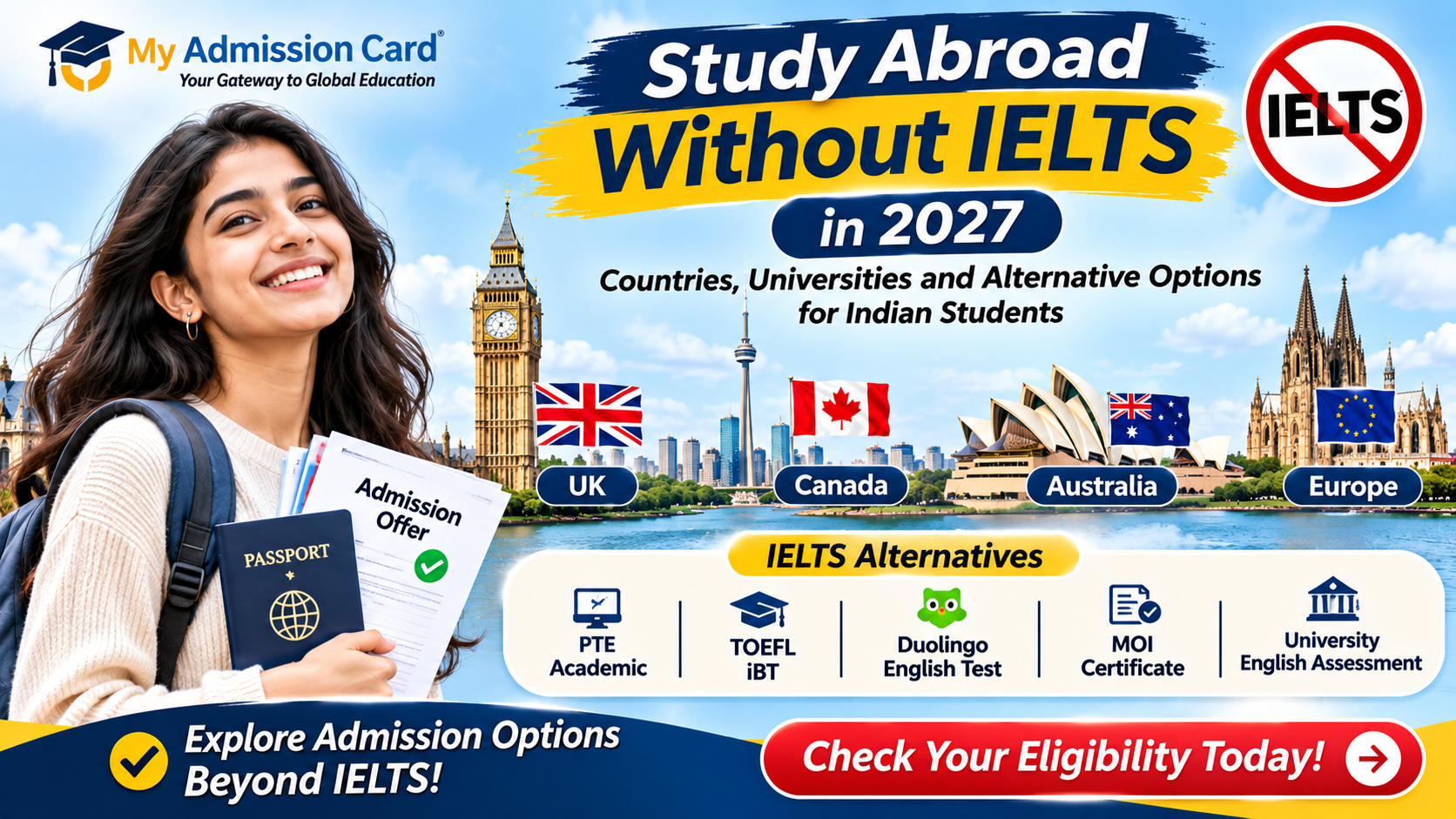
In this guide, we explore countries, university examples, alternative English tests and admission options for Indian students planning to study abroad in 2027.
1. Can You Study Abroad Without IELTS in 2027?
Yes. Depending on the university, course and country, you may be able to secure admission without submitting an IELTS score.
Universities may accept:
- Proof that your previous education was delivered in English.
- A Medium of Instruction (MOI) certificate from your school or university.
- Alternative English tests such as PTE Academic, TOEFL iBT or Duolingo English Test, where accepted.
- An internal English assessment or university interview.
- Completion of an approved English-language pathway programme.
Important: An MOI certificate is not automatically accepted by every university. Some institutions accept it only for specific qualifications, countries or academic programmes.
You should also distinguish between university admission requirements and immigration requirements. A university may waive IELTS for admission, but the visa authority may have separate English-language evidence rules.
2. Best Countries to Study Abroad Without IELTS
A. United Kingdom
The UK is one of the destinations where students may have alternatives to IELTS, depending on their university and course.
For degree-level courses, certain UK higher education providers can assess a student's English proficiency themselves, provided the assessment meets the relevant immigration requirements.
Possible alternatives include:
- PTE Academic, where accepted.
- TOEFL iBT, where accepted.
- Previous English-medium qualifications, subject to the applicable rules.
- University-conducted English assessments.
- Approved English-language pathway programmes.
An important UK visa rule: For degree-level or higher study, the required English standard is generally CEFR B2. A qualifying higher education provider with a track record of compliance may assess the student's English and record the assessment method on the Confirmation of Acceptance for Studies (CAS).
For an overseas degree taught in English, additional qualification and language verification through Ecctis may be required.
Official information: https://www.gov.uk/student-visa/knowledge-of-english
B. Canada
Canada is another destination where Indian students may find universities accepting English proficiency tests other than IELTS.
The university or college generally determines its own English-language admission requirements.
Some institutions accept:
- Duolingo English Test.
- TOEFL iBT.
- PTE Academic.
- CAEL.
- Previous English-medium education, where permitted.
University example: University of British Columbia (UBC)
UBC lists several ways to meet its English Language Admission Standard, including IELTS Academic, TOEFL iBT, PTE Academic, CAEL and Duolingo English Test.
For its undergraduate admissions standard, the published Duolingo requirement is an overall score of 125, with minimum component scores.
Official information: https://you.ubc.ca/applying-ubc/requirements/english-language-competency/
Remember: These are university admission requirements, not a guarantee of study permit approval. Check the latest Canadian immigration requirements and the specific institution's rules before applying.
C. Australia
Australia offers multiple recognised English-language tests for international students.
Students may be able to use alternatives such as:
- PTE Academic.
- TOEFL iBT.
- Cambridge C1 Advanced.
- Other approved tests listed by the Department of Home Affairs.
Some applicants may qualify for exemptions from providing English test evidence for a Student visa, depending on their circumstances.
However, Indian applicants should not assume that studying in an English-medium school or holding an MOI certificate automatically qualifies them for an Australian student visa exemption.
University example: Adelaide University
Adelaide University publishes English-language requirements covering IELTS Academic, TOEFL iBT, PTE Academic and Cambridge English qualifications. Requirements vary by programme.
Official information: https://adelaide.edu.au/study/international-students/how-to-apply/entry-requirements/english-language-proficiency/
Australian visa information: https://immi.homeaffairs.gov.au/visas/getting-a-visa/visa-listing/student-500
D. Germany
Germany can be an attractive option for students interested in engineering, technology, management and research.
However, English-language requirements depend on whether you choose an English-taught or German-taught programme.
For English-taught courses, universities may accept IELTS, TOEFL or other recognised evidence of English proficiency. Some institutions may consider previous English-medium education, subject to their rules.
For German-taught programmes, students generally need to demonstrate German-language proficiency through an accepted qualification.
Students should check the specific course requirements rather than assuming that Germany offers admission without IELTS across the board.
Useful resource: https://www.daad.de/en/
E. Other European Countries
Countries such as France, Italy, Ireland, the Netherlands and other European destinations offer English-taught programmes.
Some universities may accept alternative English tests or consider previous education in English.
However, requirements vary significantly between institutions and programmes.
Before applying, check:
- Whether the course is taught entirely in English.
- Which English tests are accepted.
- Whether an MOI certificate is considered.
- Whether an interview or internal assessment is available.
- Whether additional English evidence is required for the visa.
3. Alternative English Tests Accepted by Universities
If you do not want to take IELTS, you may have other options.
English testWhat it offersPTE AcademicComputer-based English proficiency assessmentTOEFL iBTAcademic English proficiency testDuolingo English TestOnline English proficiency assessment, accepted by participating institutionsCAELAcademic English test accepted by selected Canadian institutionsCambridge EnglishRecognised English qualifications, subject to university requirementsUniversity English assessmentAssessment conducted by an eligible university
Not every university accepts every test. Also, an online test accepted for university admission may not necessarily be accepted for visa purposes.
For example, Australia's Department of Home Affairs does not accept evidence from English tests delivered entirely online or at home for Student visa purposes. Always check the exact test format and visa rules.
4. What Is an MOI Certificate?
MOI stands for Medium of Instruction.
It is an official document issued by your school, college or university confirming the language in which your previous education was delivered.
For example, if you completed your bachelor's degree in India and the entire programme was taught in English, your institution may issue an MOI certificate.
Some universities consider this document as evidence of English proficiency.
What should an MOI certificate contain?
A typical certificate should include:
- Your full name.
- Name of the qualification.
- Duration of the programme.
- Confirmation that the programme was taught in English.
- Official institutional letterhead.
- Authorised signature and stamp.
Important: An MOI certificate is not a universal replacement for IELTS. The receiving university must explicitly accept it, and it may not satisfy separate visa requirements.
5. Universities to Explore for IELTS Alternatives
The following are useful starting points for students researching alternative English-language requirements.
UniversityCountryAlternative options to exploreUniversity of British ColumbiaCanadaTOEFL, PTE, Duolingo, CAELUniversity of TorontoCanadaTOEFL, PTE, Duolingo and other listed optionsAdelaide UniversityAustraliaTOEFL, PTE, Cambridge EnglishUK universitiesUKApproved tests, eligible provider assessment and qualifying English-medium qualifications
These are examples, not a blanket IELTS waiver list. Requirements can differ by faculty, programme, qualification level and intake. Confirm the 2027 requirements directly with the university before applying.
6. Documents Required to Apply Without IELTS
If you plan to apply using an alternative English-language qualification or an MOI certificate, prepare the following documents:
- Class 10 and Class 12 marksheets, where applicable.
- Bachelor's degree certificate and transcripts, for postgraduate applications.
- Medium of Instruction certificate, if applicable.
- Passport.
- Statement of Purpose (SOP).
- Letters of Recommendation (LORs), where required.
- Updated CV or resume, where required.
- Alternative English test results, if applicable.
- Work experience documents, if required.
The university may request additional documents depending on the programme.
7. Advantages and Disadvantages of Applying Without IELTS
Advantages
- More flexibility when selecting universities.
- Potential savings on English test fees.
- More admission pathways for eligible students.
- Opportunity to use existing English-medium qualifications.
- Alternative tests may offer greater convenience.
Things to consider
- Not all universities accept MOI certificates.
- Some universities may conduct their own assessments.
- Visa requirements may differ from admission requirements.
- Alternative tests can also involve preparation and fees.
- Course-specific English requirements may be higher.
My advice is to compare the university's admission requirements with the relevant immigration rules before making an application.
8. How My Admission Card Can Help You
Finding universities that accept alternatives to IELTS can be confusing. A university may accept an MOI certificate for admission, while another may require PTE, TOEFL or a different assessment.
At My Admission Card, we help students explore international education opportunities based on their academic background, preferred destination, budget and career goals.
Our guidance includes:
- University and course shortlisting.
- Academic eligibility assessment.
- Exploring universities with IELTS alternatives.
- Understanding MOI certificate requirements.
- Admission application guidance.
- Scholarship opportunities.
- Study abroad counselling.
You do not need to make your study abroad decision based on assumptions. Find out which universities and courses match your profile.
Check your eligibility and start planning your 2027 international education journey.
Website: https://www.myadmissioncard.com
Contact: +91 94038 93962
Email: info@myadmissioncard.com
Frequently Asked Questions (FAQs)
1. Can Indian students study abroad without IELTS in 2027?
Yes. Some universities accept alternative tests, previous English-medium education or internal assessments. However, acceptance depends on the institution, programme and applicable visa requirements.
2. Which countries allow students to study without IELTS?
Students may find IELTS alternatives in the UK, Canada, Australia, Germany and several other European countries. There is no universal country-wide IELTS waiver.
3. Can I study in the UK without IELTS using an MOI certificate?
Some students may be able to demonstrate English proficiency through a qualifying English-taught degree or a university assessment. For overseas degrees, Ecctis verification may be required. An MOI certificate alone does not guarantee acceptance.
4. Is Duolingo accepted instead of IELTS?
Some universities accept the Duolingo English Test. However, acceptance varies by university and course, and it may not be accepted for every visa application.
5. Is PTE easier than IELTS?
Both tests assess English-language proficiency but use different formats. The better option depends on your strengths, preparation style and the requirements of your chosen university.
6. Can I get a student visa without IELTS?
Possibly, depending on the country and the alternative evidence accepted under its immigration rules. University admission without IELTS does not automatically mean visa approval without English-language evidence.
Final takeaway: IELTS is an important English-language test, but it is not the only route to international education. Explore alternative options, verify the university's requirements and check the applicable visa rules before applying.