
The United Kingdom continues to be one of the most popular destinations for Indian students seeking internationally recognised qualifications, quality education and global career opportunities.
With prestigious institutions, a wide range of academic programmes, scholarships and a multicultural learning environment, the UK offers opportunities for students pursuing undergraduate, postgraduate and research degrees.
For Indian students planning to study abroad in 2027, the UK offers several attractive options across January and September intakes.
However, choosing the right university, understanding tuition fees, identifying scholarships and preparing a successful student visa application require careful planning.
In this comprehensive guide, My Admission Card explains everything Indian students need to know about studying in the UK in 2027.
1. Why Should Indian Students Choose the UK in 2027?
The UK has a long-standing reputation for academic excellence and internationally recognised qualifications.
Here are some important reasons why Indian students choose the UK:
1. Globally Recognised Universities
The UK is home to internationally respected institutions, including members of the Russell Group and other leading universities.
2. Shorter Master's Programmes
Many UK universities offer one-year full-time Master's programmes, allowing students to complete their postgraduate education in a shorter period.
3. Wide Range of Courses
Students can choose from thousands of programmes in business, engineering, artificial intelligence, healthcare, finance, law, fashion and other disciplines.
4. Scholarship Opportunities
UK universities offer merit-based scholarships, international student awards, academic excellence scholarships and country-specific funding opportunities.
5. International Learning Environment
Students interact with classmates and academics from different countries, building valuable international networks.
6. Career Development
Many universities provide career guidance, industry projects, internships and employability support.
2. Best UK Universities for Indian Students in 2027
Choosing the right university is one of the most important decisions when planning to study in the UK.
Here are some universities worth considering.
Russell Group Universities
The Russell Group represents 24 research-intensive universities in the UK.
Some leading members include:
- University of Birmingham
- University of Manchester
- University of Glasgow
- University of Liverpool
- University of Exeter
- Queen Mary University of London
- University of Leeds
- University of Nottingham
- University of Southampton
- University of Warwick
- University of Bristol
- University of Sheffield
- University of Edinburgh
- King's College London
- University College London
- Imperial College London
- University of Cambridge
- University of Oxford
- Newcastle University
- Queen's University Belfast
- Durham University
- University of York
- Cardiff University
- London School of Economics and Political Science
These universities offer programmes across business, engineering, medicine, social sciences, technology and research.
Other Popular UK Universities
Students should also consider universities outside the Russell Group, as many offer excellent teaching, industry-focused programmes and competitive scholarships.
Some options include:
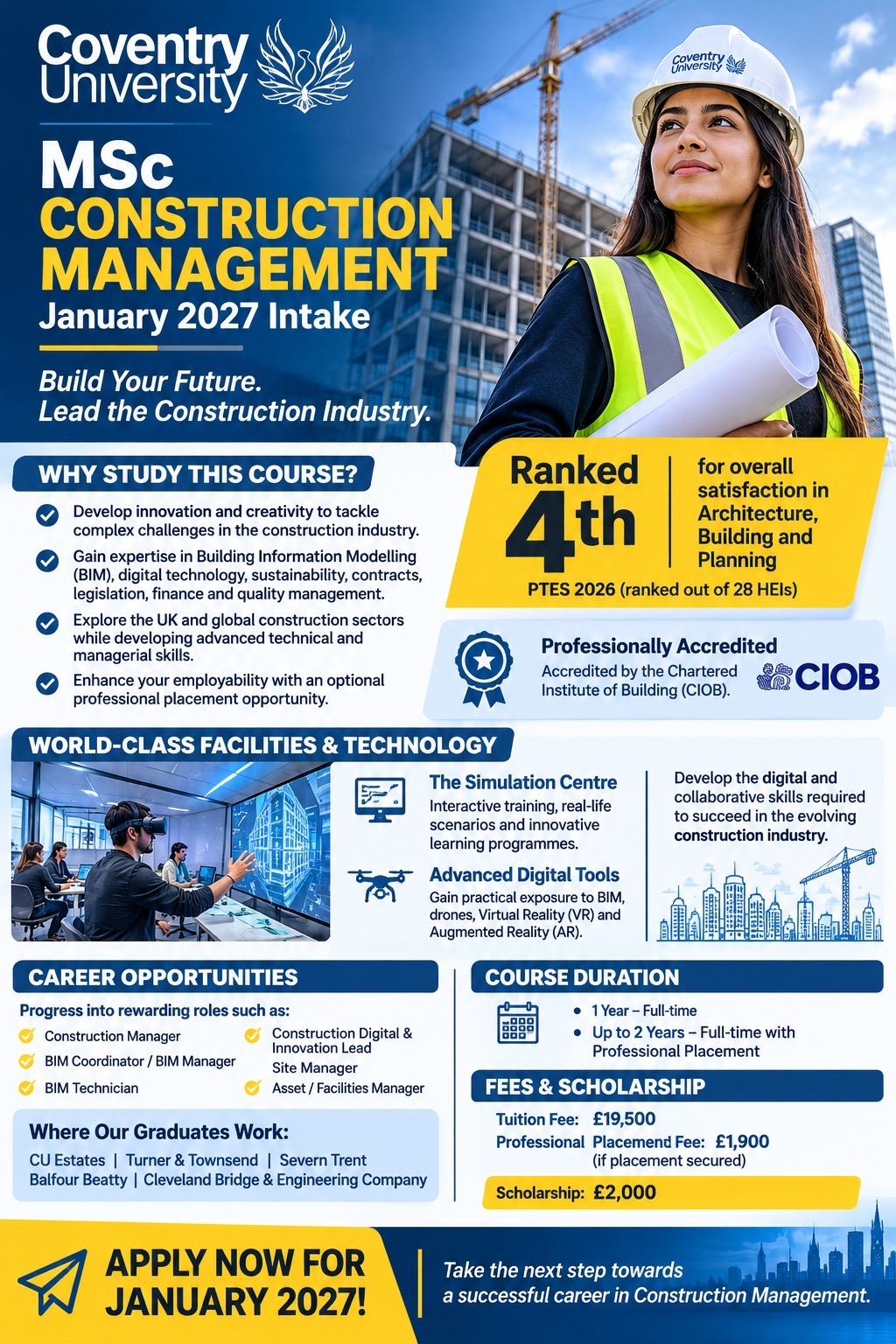
- Coventry University
- University of East London
- University of Hertfordshire
- University of Portsmouth
- University of Greenwich
- University of Sunderland
- University of West London
- University of Central Lancashire
- University of Roehampton
- University of Chester
- University of Wolverhampton
- Birmingham City University
- University of Bradford
- University of Derby
- University of Lincoln
The best choice depends on your academic profile, course preferences, budget and career ambitions.
3. Popular Courses to Study in the UK in 2027
The UK offers a wide variety of undergraduate and postgraduate programmes.
Some popular choices among Indian students include:
Business and Management
- MBA
- MSc International Business
- MSc Management
- MSc Marketing
- MSc Business Analytics
- MSc Finance
Technology and Artificial Intelligence
- MSc Artificial Intelligence
- MSc Data Science
- MSc Computer Science
- MSc Cybersecurity
- MSc Software Engineering
- MSc Business Analytics
Engineering
- MSc Mechanical Engineering
- MSc Civil Engineering
- MSc Electrical Engineering
- MSc Automotive Engineering
- MSc Renewable Energy Engineering
Healthcare and Life Sciences
- MSc Public Health
- MSc Nursing
- MSc Biotechnology
- MSc Pharmaceutical Sciences
- MSc Healthcare Management
Creative and Professional Programmes
- MSc Luxury Brand Management
- MA Fashion Management
- MSc International Hospitality Management
- LLM International Law
- MSc Project Management
Students should select programmes based on their previous academic qualifications, professional interests and future career objectives.
4. Cost of Studying in the UK in 2027
Understanding the complete cost of education is essential before applying to a UK university.
The total investment includes tuition fees, accommodation, food, transportation, visa expenses and other personal costs.
Estimated Annual Tuition Fees
ProgrammeIndicative tuition feesUndergraduate£11,400–£38,000Postgraduate Master's£9,000–£30,000MBAVaries considerably by universityPhDProgramme and research dependent
These are indicative ranges, not guaranteed 2027 university fee quotations. Medical and specialist programmes may cost considerably more.
Estimated Monthly Living Expenses
ExpenseLondonOutside LondonAccommodation£750–£1,000£500–£750Food and groceries£150–£250£120–£200Transportation£100–£180£50–£100Personal expenses£150–£250£100–£200
Actual expenses depend on accommodation type, city and lifestyle.
For general budgeting, students can expect living costs of approximately £1,300–£1,400 per month in London and £900–£1,300 outside London.
5. Scholarships for Indian Students in the UK in 2027
Scholarships can make international education more affordable.
Many UK universities offer financial support to international students, including Indian applicants.
Here are some opportunities worth exploring.
A. University of Birmingham Scholarships
The University of Birmingham offers international scholarships for eligible students.
Students can explore academic merit awards and other funding opportunities for selected programmes and intakes.
B. University of Glasgow Scholarships
The University of Glasgow offers international student scholarships across selected academic disciplines.
Students should check the available awards for September 2027 entry.
C. University of Liverpool Scholarships
The University of Liverpool provides international scholarships and tuition fee awards for eligible applicants.
The available funding depends on the programme and academic profile.
D. University of Exeter Scholarships
The University of Exeter offers international scholarships across selected undergraduate and postgraduate programmes.
E. University of East London Scholarships
The University of East London offers scholarships and financial awards for eligible international students.
Students should check the latest awards for their selected course and intake.
F. Chevening Scholarships
Chevening is a prestigious UK Government scholarship programme supporting eligible international students pursuing a one-year Master's degree.
G. Commonwealth Scholarships
The Commonwealth Scholarship Commission provides funding opportunities for eligible students from Commonwealth countries, including India, subject to programme conditions.
Important: Scholarship amounts, application deadlines and eligibility criteria change each academic year. Always verify the latest details directly with the university or scholarship provider.
6. January 2027 vs September 2027 Intake in the UK
Most UK universities offer multiple admission cycles, although not every course is available in every intake.
January 2027 Intake
January is a popular alternative for students who missed the September admission cycle.
Potential advantages include:
- An additional opportunity to begin studying without waiting until September.
- Availability of selected postgraduate programmes.
- More time for some students to prepare applications and finances.
However, course availability is limited compared with September at many institutions.
Students should immediately check application deadlines, deposit requirements and CAS issuance timelines.
September 2027 Intake
September is the main admission cycle for most UK universities.
Potential advantages include:
- Wider course availability.
- More undergraduate and postgraduate options.
- Greater choice of universities.
- More scholarship opportunities at selected institutions.
- Access to a wider range of university activities and student societies.
My Admission Card recommendation: Students who have not yet finalised their university selection should start preparing for September 2027 while checking any suitable remaining January 2027 opportunities.
7. Eligibility Requirements to Study in the UK
Admission requirements vary by university, programme and academic level.
Undergraduate Admission
Indian students generally need:
- Class 12 qualification from a recognised board.
- Required academic marks.
- Subject-specific qualifications where applicable.
- English language proficiency.
- Additional documents required by the university.
Some universities may accept direct undergraduate applications, while others may require a foundation year.
Postgraduate Admission
For Master's programmes, students generally need:
- A recognised bachelor's degree.
- Required academic marks or equivalent classification.
- Relevant subject background where applicable.
- English language proficiency.
- Statement of Purpose.
- Academic references.
- CV or work experience where required.
Some universities accept applicants with different academic profiles through individual assessment.
8. English Language Requirements: Is IELTS Mandatory?
IELTS is one of the most commonly accepted English language tests for UK university admissions.
However, it is not the only option.
Depending on the institution and programme, students may be able to submit:
- IELTS Academic
- PTE Academic
- TOEFL iBT
- Other accepted English language qualifications
- Evidence of previous English-medium education, where permitted
Some universities offer their own English language assessments or pre-sessional English courses.
Students should distinguish between university admission requirements and UK Student visa English language requirements.
The university must confirm whether the student's English language evidence meets the applicable requirements.
9. UK Student Visa Requirements for Indian Students in 2027
Indian students who receive an eligible offer from a licensed UK Student sponsor must obtain the appropriate Student visa before travelling to the UK.
The general requirements include:
- Confirmation of Acceptance for Studies (CAS).
- Valid passport.
- Evidence of required tuition and living funds.
- English language evidence.
- TB test certificate, where required.
- ATAS certificate, where applicable.
- Additional documents depending on individual circumstances.
Student Visa Financial Requirements
Students applying from India generally need to demonstrate sufficient funds for:
- Outstanding tuition fees for the relevant academic year, up to nine months.
- Living expenses for up to nine months.
The current published maintenance amounts are:
LocationMonthly requirementMaximum for 9 monthsLondon£1,529£13,761Outside London£1,171£10,539
The required money generally needs to be held for 28 consecutive days, with the evidence meeting the relevant UKVI timing requirements.
UK Student Visa Fees
The published Student visa application fee for applications made outside the UK is £558.
The Immigration Health Surcharge for students is £776 per year, calculated according to the total visa duration.
These charges are separate from university tuition fees and living expenses.
Students should check the latest official UKVI fees before submitting their applications.
10. Can Indian Students Work While Studying in the UK?
Eligible international students studying full-time degree-level courses at qualifying higher education providers can generally work up to 20 hours per week during term time and full-time during official vacations.
However, employment conditions depend on the course, sponsor and visa conditions.
Students must always follow the working conditions printed on their immigration permission.
Part-time work should be treated as an opportunity to gain experience and supplement income, not as a guaranteed way to finance tuition or living expenses.
11. UK Post-Study Work Visa: Important 2027 Update
The Graduate Route allows eligible international graduates to remain in the UK after successfully completing an eligible course.
However, students planning to start their studies in 2027 should understand an important immigration change.
Under the published rules:
- Applications made on or before 31 December 2026 qualify for two years for eligible bachelor's and Master's graduates.
- Applications made on or after 1 January 2027 qualify for 18 months for eligible bachelor's and Master's graduates.
- Eligible doctoral graduates continue to qualify for three years.
This means Indian students completing a typical one-year Master's programme in 2027 should plan on the 18-month Graduate Route, subject to eligibility and the rules in force when they apply.
The Graduate Route is not extendable, although eligible graduates may be able to switch to another immigration route, such as the Skilled Worker route.
Students should never choose a university based solely on assumptions about post-study employment or visa duration.
12. How to Apply to UK Universities for 2027
The application process generally involves the following steps.
Step 1: Select your preferred course
Identify programmes that match your previous qualifications and career goals.
Step 2: Shortlist universities
Compare rankings, tuition fees, scholarships, course modules and location.
Step 3: Check eligibility
Review academic requirements and English language criteria.
Step 4: Prepare documents
Common documents include:
- Academic transcripts.
- Degree certificates.
- Passport.
- Statement of Purpose.
- Letters of Recommendation.
- CV, where required.
- English language test results, where required.
Step 5: Submit your application
Most international postgraduate applications are made directly through university application portals.
Undergraduate applicants generally apply through UCAS.
Step 6: Receive your offer letter
The university may issue a conditional or unconditional offer.
Step 7: Complete admission conditions
Submit outstanding documents, meet English language requirements and pay the required deposit where applicable.
Step 8: Receive your CAS
The university issues the CAS after completing the relevant checks.
Step 9: Apply for your Student visa
Prepare financial evidence and supporting documentation before submitting the application.
Step 10: Prepare for departure
Arrange accommodation, travel, insurance requirements and other essential arrangements.
13. Common Mistakes Indian Students Should Avoid
Before applying, students should avoid these common mistakes:
- Selecting universities without checking eligibility.
- Applying only to highly competitive institutions.
- Ignoring scholarship deadlines.
- Choosing courses unrelated to previous qualifications without explaining the academic progression.
- Underestimating living expenses.
- Submitting incomplete financial documents.
- Paying deposits without verifying university and payment instructions.
- Assuming that every university offers January and September intakes.
- Relying on outdated visa information.
- Making career decisions based on guaranteed job or visa promises.
Careful planning can make the entire admission process more organised and reduce avoidable mistakes.
14. Why Choose My Admission Card for Your UK Education Journey?
Choosing the right UK university involves more than selecting a university based on its ranking.
Students need to understand academic eligibility, course suitability, scholarships, tuition fees, admission deadlines and visa requirements.
My Admission Card helps students navigate this journey through:
- UK university shortlisting.
- Course selection and academic eligibility assessment.
- University comparison.
- Scholarship identification and guidance.
- Application and documentation assistance.
- Offer letter guidance.
- Student visa application support.
- Pre-departure guidance.
Whether you are planning for January 2027 or September 2027, our objective is to help you identify suitable universities based on your academic background, budget and career aspirations.
We believe that students should have access to transparent information before making one of the most important investments of their lives.
Frequently Asked Questions (FAQs)
1. How much does it cost to study in the UK for Indian students in 2027?
Tuition fees generally range from £11,400 to £38,000 for undergraduate programmes and approximately £9,000 to £30,000 for postgraduate programmes. Living expenses are additional.
2. Can Indian students study in the UK without IELTS?
Yes, some universities accept alternative English language tests or other approved evidence of English proficiency. Requirements vary by university and course.
3. Which UK universities offer scholarships to Indian students?
Universities including Birmingham, Glasgow, Liverpool, Exeter and East London offer various international scholarship opportunities. Availability and eligibility depend on the programme and intake.
4. Is January 2027 intake available in the UK?
Yes, several UK universities offer January 2027 admission. However, deadlines and course availability vary, and some application windows may already have closed.
5. Can Indian students work part-time in the UK?
Eligible degree-level students at qualifying higher education providers can generally work up to 20 hours per week during term time, subject to visa conditions.
6. What is the UK Graduate Route duration for students graduating in 2027?
Under the published rules, eligible bachelor's and Master's graduates applying from 1 January 2027 will receive an 18-month Graduate Route. Eligible doctoral graduates receive three years.
7. How much bank balance is required for a UK Student visa?
Students must demonstrate outstanding tuition fees for the relevant period and maintenance funds of £1,529 per month in London or £1,171 per month outside London, for up to nine months, subject to applicable exemptions.
8. When should Indian students apply for September 2027?
Students should begin researching universities and preparing applications well in advance. Some undergraduate applications have central UCAS deadlines, while postgraduate deadlines are determined by individual universities and programmes.
Start Your UK Study Journey with My Admission Card!
The UK offers exciting academic opportunities for Indian students, from internationally recognised universities to specialised postgraduate programmes and scholarship opportunities.
The key is choosing the right university, the right course and the right intake.
Let My Admission Card help you explore your options and plan your international education journey with confidence.
Get Started Today!
Website: www.myadmissioncard.com
Phone: +91 94038 93962
Email: info@myadmissioncard.com
My Admission Card – Your Gateway to Global Education.